
There are two interesting facts about black holes that — when considered together and carried forward to their logical conclusion in one particular, often overlooked way — reveal a surprising, previously unrecognised feature of the nature of black holes. These facts are well-recognised, commonly-acknowledged truths about black holes. But when taken together, the requirement set by their union in one particularly important scenario reveals that we’ve previously misunderstood a key feature of the relativistic geometry of black holes.
The first of these interesting facts is that after a star implodes, if it is large enough and there is no known force in nature that can halt its collapse, to anyone in the external universe the star will “appear” to take forever just to contract to the radius of its event horizon — the boundary at which gravity becomes so strong that nothing, not even light, can escape. The black hole therefore never quite “appears” to form at all, but only “appears” to shrink ever closer to the time — towards the specific event — when the surface finally contracts to the event horizon radius.
(Note that the scare quotes around “appear” in this paragraph are important because, in addition to this apparent freezing that happens partway through the collapse, as the star approaches the size of a black hole, even if it is continually emitting light towards the outside universe, that light quickly becomes so highly redshifted — stretched to longer and longer wavelengths, making it dimmer and dimmer — that it also becomes practically unobservable. Nevertheless, if you had a magic antenna that could detect radio waves of any wavelength, you could “see” the star forever contract down to the finite radius of its event horizon, never “appearing”, through the antenna signal, to become a black hole. This “magic antenna” device is standard practice in relativity: we reason about what signals are in principle available, not what’s practically detectable.)
The second interesting fact is that the collapsing star and everything that ever falls into it will actually reach the event horizon in finite time when measured on their own personal clocks. Thus, while everything in the outside universe “sees” the collapsing star and everything that falls in afterwards take forever to get there, everything that falls in and actually reaches the event horizon does so in finite time.
These two facts are canon. Everyone knows them; no one contests them.
Now, before considering what their union entails for the nature of the event horizon, there is one more fact of modern physics to be clear about: since light travels at finite speed, we never observe any thing-in-itself; we only ever see images made up of photons those things scattered or emitted sometime in the past. Those images travel across space at the finite speed of light, so everything we see is an image of a thing, not the thing itself; and the image shows what the thing looked like sometime in the past, not what it looks like now.
Just think about what this means for what you see when you look down the street. The closest building to you is a shorter light-distance away than anything beyond it. So the image you see is a ray of light carrying photons—information—that were emitted from the furthest building first, then the next, and so on. On its way to your eye, the light ray that forms the full image you see picked up photons at each of the buildings at later and later times until finally the photons from the nearest building joined in, and later still all those photons reached your eye.
This is a geometric truth with direct application to the physics of causal observation.
This means we never see images of things “as they were, in an instant”, but amalgams of light that was emitted at different times along the image’s depth, which carry information about the thing.
In terrestrial settings, the technical difference between the two is completely insignificant. If you stand in a flat field and look out, you can see maybe ten kilometers. But light travels three hundred thousand kilometers every second. Therefore, when you look out at the field you’re technically seeing “an amalgam of photons emitted across a time span of 0.00003 seconds”. That’s an instant, in any practical sense.
But at astronomical scales, the effect is significant. Picture the other large galaxy in our Local Group: Andromeda. This spiral galaxy we see nearly edge-on is 2.5 million light years away and roughly one hundred thousand light years in diameter. Therefore, when we look at Andromeda through a telescope, far from seeing it “as it is now” or even “as it was at some instant two-and-a-half million years ago”, what we’re really seeing is an image across time—one that spans its whole lookback distance. The photons we now see from the far side were emitted a hundred thousand years before the photons we’re seeing from the near side. They travelled from an earlier time, continuously picked up more-recently emitted photons along the way, and over the course of a hundred thousand years that amalgam of photons formed the image of Andromeda we see today. That image, carrying information across a significant depth of lookback times, then travelled two-and-a-half million years through space to reach our telescopes.
The union
Now, any coherent description of “what black holes are” must consistently account for all three of these basic facts, in any scenario we can dream up. It is not enough to construct descriptions in which all three are satisfied individually—that individually what we see is an image in the full sense of what that means; that every outside observer “sees” black holes asymptotically approach the size of their horizons in infinite time; and that everything that ever falls in reaches the event horizon in finite personal time (this is called “proper time” in the language of Einstein’s relativity). All three must not merely hold true individually; they must all be true together, under every circumstance.
In particular, consider what is described from the relative perspective of an astronaut who dives into the black hole long after the supernova explosion that formed it.
To keep things simple, we’ll equip the astronaut with one of those magic antennas they can use to always “see” the faint radio signal from the collapsing star — i.e. the signal that must have been emitted before the star contracted to the size of its event horizon, which is all that’s ever visible from outside the black hole.
At every moment as the astronaut approaches the event horizon, they still see the star with a radius larger than its event horizon. Even in the limit as they approach the horizon’s finite radius, they always “see” an image that was emitted when the star was larger than the horizon radius, when the star’s surface was still somewhere between the horizon radius and the astronaut’s location when they later “see” the image.
When the astronaut reaches one meter above the horizon, they “see” photons emitted by the star when it was less than a meter away, when it was still larger than its horizon. When they’re a nanometer from the horizon radius, they see the star’s surface—an image of it, as always—that originated from less than a nanometer away, as the star was still larger than its event horizon when the current image the astronaut “sees” was emitted.
In the limit, both the surface of the star and the astronaut approach the event horizon radius from the outside, and they reach that radius together in the infinite limit. This is a geometric fact—a theorem proven in a paper I recently completed.
The whole thing makes a lot of sense when you note that the geometry is equivalent to the one in the following scenario. Imagine we see Andromeda start to contract along the dimension that points radially away from us, and that it does so in such a precise way that the far side and the near side come to a point in the infinite future. The entire diameter of the galaxy, every point in the space that separates the near and far sides, comes together at a time that’s infinitely far into the future.
The lookback distance across the galaxy as you watch it therefore shrinks for the rest of time, until the lookback distance across the span of the galaxy in the final image that’s emitted at the end of time has a span of zero. In that limit, there is no spatial distance left between any of the final emission events, and there is no timelike separation between them either. All the individual emission events that comprise the final image of the galaxy, spanning the near to the far side, are therefore also the same event. It is an “event-of-events” in which the last photons are emitted from all the individual points that had always been separate, spanning the galaxy — but at the end of time they are emitted from the exact same point in space, instantaneously.
Actually, in addition to being a set of individual events, in a precise mathematical sense, within this event-of-events that occur with no separation in space and time, they also retain a mathematical property known as causal order: even though the final set of emission events happens coincidentally in that final instant, technically the photon from the far side still occurs, in the sense of its causal order, “before” the next furthest, and so on.
This is the core geometric theorem in my paper. It proves that the final singularity in this scenario — the coincidental event-of-events at the end of time — occurs with no meaningful separation between them in either space or time, even though the individual events do retain both distinctness and causal order in that final, singular, horizon event.
And it turns out that the spacetime geometrical structure this scenario captures is identical to the geometrical structure of gravitational collapse to a black hole’s event horizon.
So in the mathematical limit, at the exact moment when the astronaut reaches the horizon in the scenario from above, they finally see that the star too has only just reached its horizon radius: at that moment, the path of the photon across spacetime that left the surface of the star and is “seen” by the astronaut has zero length or duration. It travelled no distance through space, and arrived instantaneously, and the spacetime separation between the signal’s emission event on the star’s surface and the astronaut’s observation event is zero.
In other words, the collapsing star and the astronaut must, by a pure geometric proof, arrive at the event horizon together, coincidentally.
Even though the black hole may have begun collapsing a billion years before the astronaut dove in, it turns out that the astronaut must catch up with the collapsing star’s surface, and must do so exactly at the event horizon — by the basic structure of the black hole’s geometry. Throughout the course of their fall, the radial separation between the point at which the most recent image was sent, and the point of observation, — that gap, — decreases continuously throughout their descent — in a manner that is geometrically equivalent to the shrinking lookback depth of Andromeda in the thought experiment above.
Only at the event horizon does the gap separating “the star’s surface at the moment that’s now being seen” and “the astronaut’s position now” finally become identically zero — so the time between emission and observation likewise goes to zero.
Mathematically, the two events—namely, “when the collapsing star reaches the horizon,” and “when the astronaut reaches the horizon”—are distinct. They correspond to two separate bodies crossing the event horizon radius. The mathematical sense in which these events are said to be “distinct” is called topological — meaning they remain individually identifiable as separate points, the way two dots on a rubber sheet remain two dots no matter how you stretch it. And they also retain the topological property of causal order: the moment when the star’s surface reaches its horizon causally occurs “before” the moment when the astronaut reaches the horizon — even though the events coincide in both space and in time. But these two properties — event “individuation” and causal order—are purely topological, just as the equivalent events were in the “shrinking Andromeda” thought experiment. And that is different from being geometrically distinct.
That is: from a geometrical standpoint, these two distinct, causally ordered events are exactly coincidental — i.e. they happen at exactly the same place and time.
And the reason is not at all exotic or weird. Much like if a train were a finite distance away and rolling down a track, and you started walking towards it at a greater speed than it was receding, you would close the gap as you walk, right up to the moment when you finally reach it. And as you close that gap, the image of the train will have been sent more and more recently as the gap between the emission and observation points becomes less and less. When you eventually reach the train, the image won’t have to travel across space and won’t require any time to reach you: you’ll be right then and there as the final image is “emitted.”
This train example is like the situation with the black hole’s event horizon, except that the only place and time the collapsing star can actually be reached—which is in fact when and where it is reached by everything that ever falls into it, as an exact geometric fact—is the fixed event horizon. Not only do the originally collapsing star and infalling astronaut meet there and then,—every particle that falls in throughout all of cosmic time must reach the event horizon coincidentally with the originally collapsing star and the astronaut. Each one approaches the event horizon asymptotically, and reaches it coincidentally.
Far from being a “thing that exists out there”, in space at any finite time, it turns out that the event horizon is correctly described as an event—an occurrence—that happens at the end of the universe, when cosmic time finally runs out.
Comments regarding the traditional description
Black hole event horizons have traditionally not been described this way. Commonly, the event when the collapsing star shrinks to its own event horizon radius is treated as temporally (in the geometric sense) “earlier” than “later” horizon crossing events, and the event horizon is thought of as a thing that “exists, out there” in our universe.
But in this paper of mine, I proved that this is a misinterpretation of the geometry — which is likely due to the misleading nature of projections we often use to represent it. You see, in general relativity we represent curved spacetime geometries by projecting them onto flat planes, much like the Earth’s curved surface can be projected to a flat plane to create maps — the Mercator projection being the most common of these. Such projections distort the underlying geometry in various ways, but they are really just representations of the four-dimensional curved spacetime geometry — and there are fixed geometric properties, called invariants, that must hold true no matter which projection is used.
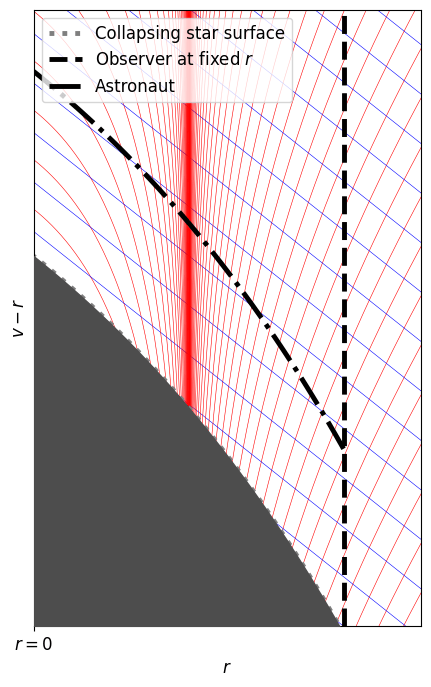
And a particularly significant invariant property of the geometries that describe gravitational collapse is that there is zero geometrical separation among the events that make up their event horizons. They are individual events, they have causal order, but they’re all coincident occurrences. They all happen at the same place at the same time, in a geometrically invariant sense.
What’s not been well understood within the traditional picture of black holes, that didn’t consistently account for the logical union of the three basic facts listed above, is that the projections that “maximally extend” the event horizon so it appears to form a line with constant radius across a range of “time” values, rather than displaying the event of events as the singular occurrence it is, cannot be interpreted to mean that those individual, causally ordered events are temporally separate. They are not, and by the most basic invariant property of any spacetime geometry—ie, its causal structure, the grid of null lines along which spacetime separation is zero. Instead, these maximal extensions are interesting precisely because they do show the individual events causally laid out as they must be in a topological sense—even though they are a set of singularly occurring, coincident events. (Yes, the spacetime projection shown here, known as an “ingoing Eddington-Finkelstein diagram”, is an example of a projection showing such a “maximally extended” geometry.)
The metric singularity
Ultimately, what this all comes to imply is that the event horizon is a special category of singularity that physicists have not properly understood previously. But with everything discussed above, it’s a distinction that can now be easily explained if we start by clarifying the definitions of a few more mathematical pieces.
Essentially, what we need to do is distinguish between the manifold, which is a topological structure — a set of points and rules about how they relate to one another, — the metric, which is the thing that gives length to the relationships between manifold points in a coordinate system-invariant way, and the various coordinate systems that can be used within that metric — e.g. like describing space via a Cartesian (x,y,z)-mesh versus radial and angular polar coordinates, which are defined relative to a central point.
Now, the key thing to note is that one and the same manifold can be described by different metrics, but once a metric has actually been selected and attached to the manifold, that move restricts the geometry in a way that’s independent of the coordinate system we might use to describe it.
Having established these concepts and definitions, we can discuss the various types of “singularity” that exist in metric spaces. For instance, the singularity at r = 0 in the global extension of the Schwarzschild geometry of a black hole is a manifold singularity. This means that regardless of which metric you select to describe the manifold, or the coordinates you pick to project the geometry so-defined by that metric on that manifold, this singularity is actually a puncture point in the manifold itself. This singularity doesn’t even exist within the basic set of points that makes up the manifold. The curvature in the vicinity, regardless of metric, approaches infinity from all directions and the exact singularity point itself just isn’t there. This means, for instance, there can be no metric that would enable you to draw a line through that point, because that point is not there at all. It’s a hole in the manifold, in a metric-invariant sense.
The event horizon is not that kind of singularity, as we’ve known for nearly a century. It was proven by Robert Oppenheimer and his graduate student, Hartland Snyder. The manifold itself is not missing any points at the event horizon. You can attach any metric you want to it, and along that metric you can always draw lines that cross right through the event horizon.
But since the 1960s physicists have taken that fact to mean that the event horizon, since it’s not a curvature singularity, is “just a coordinate singularity”. You see, a coordinate singularity is something like the poles on the surface of a globe. The lines of longitude all converge on the two poles, and those two points, at latitudes +/-90 degrees, are points of every longitude, all-at-once. But the important thing about such coordinate singularities is that they’re really just artifacts of the specific coordinate system chosen — not singularities of the manifold or even of the metric. With the same metric, a different coordinate system can be chosen (e.g. stereographic coordinates on the sphere) that is nonsingular there and shows the geometry is perfectly regular there.
But the thing about the event horizon is that it is identically singular in a purely metrical, non-manifold sense. The event horizon is geometrically defined by the property that in the geometry of a black hole — which is defined by the manifold and the metric as a pair — the separation between all manifold points at the horizon, when described with any coordinate chart (i.e. in a coordinate system invariant sense), is identically zero.
So in that sense, as Oppenheimer and Snyder proved, the manifold is indeed regular at the horizon, but that regularity does not mean the event horizon is “just a coordinate singularity” at all. What it is instead, in a very precise geometrical and topological sense, is a metric singularity. It is a region of the coordinate-invariant metric at which individual points all have zero separation between them, as an identity of the metric itself.
Now, every individual fact in the above description is well known. It is well known that the manifold is smooth at the horizon. It is well known that the spacetime interval along null generators that define the causal structure of a spacetime metric is identically zero. It is well known that this is not a coordinate artifact — it holds in every admissible coordinate system, because it follows from the metric’s defining causal structure itself. And it is well known that the horizon events are distinct points of the manifold with a well-defined causal ordering.
None of this is new or controversial. Every working relativist knows all of it.
What has been missed is that these well-known facts, taken together, constitute a third type of singularity — one that is categorically distinct from both of the other two. A manifold singularity is where the manifold itself is incomplete: the point isn’t there, curvature diverges, and no metric can extend through it. A coordinate singularity is where a particular chart breaks down, but the metric is perfectly regular in other coordinates — nothing physical is happening. A metric singularity is something else entirely: the manifold is smooth, the metric is smooth in appropriate coordinates, but the metric nevertheless fails to distinguish points that the manifold keeps distinct. The geometry assigns zero separation — zero spatial distance, zero temporal duration — to events that are topologically individual and causally ordered. The metric is not misbehaving. It is doing exactly what a spacetime metric does along its null directions. But the consequence — that it cannot individuate events that the topology individuates — is physically significant, and has not been recognised as its own category of singularity until now.
This is the category to which the event horizon belongs. Not a manifold singularity: the manifold is complete and smooth. Not a coordinate singularity: the zero separation is invariant and no coordinate transformation can make it nonzero. It is a metric singularity: a physically meaningful degeneracy in which the metric’s ability to measure distances and durations collapses to zero along the horizon generators, even as the manifold and its causal structure remain perfectly intact.
And the reason this matters — the reason it is not merely a relabelling of known facts — is that the conclusions one draws from the geometry depend entirely on whether one recognises this as a distinct category. When physicists classified the horizon as “just a coordinate singularity”, the implicit message was: nothing geometrically significant happens there. The metric is smooth, nothing blows up, an infalling observer notices nothing special. But once the horizon is recognised as a metric singularity — a surface where the metric cannot assign any nonzero separation to distinct, causally ordered events — the question of what the horizon’s geometric status actually implies is reopened entirely. And the geometric proof described here is what follows when that question is taken seriously.
The upshot
The upshot of the geometric proof of all of this is that when the facts — i) that light travels at finite speed, ii) that everything that ever drops into a black hole appears from any perspective in the outside universe to take forever to reach the event horizon, and iii) that everything that ever drops in reaches the event horizon in finite time when measured on its own clock — are carefully considered together, a rather different picture of the nature of black holes emerges.
In this picture, matter can only contract to its event horizon radius when infinite cosmic time has passed. This means every massive body in our universe is restricted by finite volume and density limits — i.e. there are no point-mass singularities in our universe. They can’t form because trapped surfaces — regions where gravity has become so overwhelming that even outward-directed light is dragged inward — can never form inside our universe at any finite external time.
As noted already, it also means that the event horizon of a black hole isn’t a surface that exists “out there” in space, but an infinite boundary occurrence — an event-of-events, that happens at the end of the universe, when all infalling particles reach the singular event-of-events coincidentally — and the universe they came from is no more.
That’s an important point to reflect on: when the event horizon occurs, cosmic time will have gone to infinity. The universe will have ended. The event horizon becomes “what exists” in an infinite future instant that is untethered to anything else.
Therefore, the implication follows that whatever happens after the event horizon, which happens in finite time from the perspective of anything that participates in the metrically singular horizon event, must happen during an existence that lies beyond our universe — beyond the bound of time’s infinite passage within our universe — something that continues after our universe makes its way to forever.
Importantly, none of this is speculative. It’s not a philosophical interpretation, an opinion, or a theory. This follows from the invariant geometry itself — the same mathematics that predicts gravitational lensing, GPS corrections, and gravitational waves. The geometric proof doesn’t say the horizon is “hard to see” or “far away” or “practically unreachable”. It says the horizon is not a present structure in our universe at all — not at any finite time — but a singular event that happens at the very end of time that bridges our universe to an existence that lies after it (or to an abrupt end for everything that falls in — which no one believes will happen since spacetime is smooth there).
It means that, in a very precise geometrical sense, black holes — the post-horizon state — are not things that “exist within our universe” at all; they come to be at the end of the universe and exist after it.
And because of the asymptotic nature of collapse in our universe, there is actually a lot we can know about the nature of these black holes. Each one will at late times be the final result of mergers within gravitationally bound galaxy clusters. Due to slow but steady loss of orbital energy via radiation and inspiralling, the event horizons we know must happen at the end of the universe will not be the asymptotic futures of any stellar black holes we observe in the universe today. They will only happen at the surfaces of supermassive black holes that grow at the centers of galaxy clusters. And because of the expansion of space surrounding each gravitationally bound mass in the universe, each one of those final black holes will by then be infinitely separated from every other one. This is what I meant above by “untethered”: each event horizon will occur when there is nothing but emptiness surrounding it. Everything that was once there but did not fall in will have moved an infinite distance away when the event horizon finally occurs.
So when event horizons do finally happen, there can be nothing else “around”. Time will have ended, space will be devoid of anything, all of it having been carried away through infinite expansion. Each event horizon happens in complete isolation, untethered to any surroundings.
And the most remarkable thing of all: in this pair of papers I just finished, I also proved a geometric theorem showing that the universes that come to be at these event horizons — because of the exact way the topology and causal order are preserved at the singularity, seeding the geometry that follows — must expand afterwards in such a precise way that they’d appear to their inhabitants to be expanding with precisely the rate our own cosmological observations have constrained for the expansion rate of our universe.
As a matter of fact, these “baby universes,” which must emerge at the event horizons of black holes according to the null-boundary correspondence theorem proven in this paper, must also all have expansion rates that slightly diverge at early times from the expansion rate described by the standard cosmological model. In the first few hundred years, the standard model predicts an expansion rate that is slowed exponentially by the energy of radiation in the hot early universe, but this extra deceleration is not a feature of the “baby universes” that follow the event horizons of black holes. Those universes must always expand, from the moment of the event horizon singularity, with exactly the flat ΛCDM expansion rate — the specific mathematical formula that best describes the measured expansion of our universe — as an algebraic identity of the basic geometry.
This difference is actually something we can check against data we’ve gathered in our universe. We can check whether our cosmological measurements fit the standard model better, or if they better fit the pure geometric expansion rate that must characterize universes born at event horizons.
The standard model predicts that radiation in the hot early universe slowed the expansion rate relative to pure flat ΛCDM, and this slowdown sets a specific distance scale — the “sound horizon” — that is imprinted in the cosmic microwave background radiation we observe today. The angular size of that imprint is one of the most precisely measured quantities in all of cosmology, and it is the basis for the most precise determination we have of the current expansion rate. But if the real expansion history is the pure geometric one that must follow an event horizon — if there was no radiation-induced slowdown in our universe — then the sound horizon would have been different, and the expansion rate inferred from the microwave background would be slightly wrong.
For the past decade, there has been a persistent, statistically significant disagreement between the expansion rate inferred from the cosmic microwave background and the expansion rate measured from bright stars and supernovae in nearby galaxies. This is known as the “Hubble tension,” and no one has been able to explain it within the standard framework. It is exactly the kind of discrepancy you would expect if the early expansion history is purely geometric and the standard model’s radiation-epoch correction is an artifact of the wrong assumption.
The comparison can be carried out with existing data. If our universe was born at the event horizon of a black hole in a previous universe, the geometry makes a specific, testable prediction — and the data to test it are already in hand.
 cosmiCave.org
Leave a comment