
As noted in Module 2 and earlier in this module, our first record of an attempt to rationally explain the universe comes from Thales of Miletus in the sixth century BCE. Natural philosophy in ancient Greece followed the tradition begun by Thales (624 BC-546 BC), which culminated in the works of Aristotle, who lived two centuries later. Afterwards, a new tradition in astronomy emerged in Alexandria, where scholars from diverse backgrounds came together. Alexandrian astronomy was more mathematical and empirical, and less philosophical than Greek cosmology had been, and flourished two centuries after Aristotle, at the time of Hipparchus (c. 200 BCE). After the time of Hipparchus, Rome’s influence increased throughout the Mediterranean, and both science and civilisation eventually declined with the gradual fall of Rome. Ptolemy was one of the last great scientists of ancient civilisation, and he lived during the second century CE.
In the centuries that followed, Christianity was increasingly dominant in Europe. Lactantius (c. 250–325 CE), who was advisor to Constantine I (the first Christian Roman emperor), as well as tutor to his son, argued that the Earth is flat because it would be absurd for a region of Earth to exist where men hung head down, rain and snow fell upward, and it should be impossible for the heavens to be below the Earth. Lactantius’ ignorance should not be taken as representative of all early Christians or their beliefs—just as no one Christian’s beliefs today should be thought to represent the whole. In contrast to Lactantius—who valued his own personal thoughts on what amounts to being “absurd” over empirical evidence and valid reasoning that people had known about for centuries—St. Augustine (354–430 CE) is an example of a well-educated early Christian scholar who did not doubt that the Earth is round. Even so, despite his education, when it came to physics and the search for scientific explanation, he wrote that
It is enough for the Christian to believe that the only cause of all created things, whether heavenly or earthly, whether visible or invisible, is the goodness of the Creator, the one true God; and that nothing exists but Himself that does not derive its existence from Him (Kuhn, 1957).
The decline of intellectual thought in the West coincided with the decline of the Roman Empire during the Early Middle Ages. Throughout this period, there were other important contributing factors to this degradation beyond the ignorant declarations of the Lactantiuses, or the repressed curiosity counselled by the Augustines, who held prominent roles within the increasingly influential Church.
While the intellectual and cultural centre during the first two centuries CE shifted west to Rome, there had been great political stability, and the population was generally well educated and bilingual, being literate in both Latin and Greek. This was the society that produced Ptolemy. However, in the early centuries of European Christiandom, the Roman Empire was repeatedly attacked from all directions and slowly deteriorated. The Germanic people who came from the north were illiterate, and their integration into society meant that the overall literacy level diminished. Furthermore, the declining political stability also meant that fewer resources could be dedicated to academic matters. The culture that arose in Early Medieval Europe did not descend from ancient Greece, inheriting its history of learning. It was one dominated by northerners who had not yet begun to search for rational truth, and who, for the most part, did not speak and could not read the language in which that tradition had existed. Early attempts to translate the ancient Greek texts into Latin failed, and the academic pursuit diminished to a handful of commentaries on ancient texts as it inevitably ground to a halt. Centuries later, during the European Renaissance, it was the descendants of this culture, having attained a degree of stability like that which had previously existed in Greece and Rome, who would rediscover the ancient knowledge that had been lost.
The reason why it is important to briefly discuss this bit of history is that it clarifies an important point which is often misunderstood about the history of astronomy. Intellectually speaking, Copernicus was the direct descendant Aristotle and Ptolemy. No other significant advance was made in the centuries that separated Copernicus from his predecessors; therefore, Copernicus’ theory was indeed proposed as an alternative to the ancient works of Aristotle and Ptolemy, which were the basis of the Early Renaissance physics and astronomy of Copernicus’ day. However, Copernicus was not a great revolutionary who finally decided that the long tradition of belief must be challenged in the name of Truth, after nearly two millennia of religious adherence to the Aristotelian worldview. In relation to the amount of time that separates Copernicus from his immediate predecessors, their works had been recovered for only a relatively short time. This happened gradually, over the few centuries leading up to Copernicus’ birth—and, importantly, a culture of healthy criticism regarding the “ancient wisdom” that the Renaissance Europeans did finally inherit had grown up along with the discovery of that inheritance.
Although Copernicus is closely connected to the ancient Greeks both intellectually, since it was their theories he studied, and geographically, as he attended the University of Padua in Italy (where Galileo later taught), there is a significant sense in which Copernicus was not their descendant. The ancient Greek culture that had sought to understand the world in the same manner that was taken up later by Galileo and Kepler—the way that today’s scientists continue to seek a better understanding of the world—had long since died out and been replaced by an intellectually less advanced one. Copernicus descended from this later culture, and he lived only a few centuries into its search to understand the physical world.
So far, we’ve discussed what the status of physics and astronomy during the 1400 years that separate Ptolemy and Copernicus was not, and we’ve discussed generally what it was like instead. We should finish this discussion of Copernicus’ heritage by noting a few of the specific things that happened leading up to Copernicus’ proposal.
First of all, as noted, most of the ancient texts were lost from Western Europe during the middle ages. Many were saved only by finding their way east during the Muslim conquests that began in the seventh century. Ptolemy’s work on astronomy was one, and the name Almagest comes from the Arabic name it attained at that time. Older texts, such as the works of Hipparchus, failed to be recopied and were lost. While the Arabs made use of the Almagest and for centuries worked to refine the system of deferents, epicycles, eccentrics and equants in order to provide the best possible description of planetary motion within an essentially Ptolemaic framework, they made no fundamental advances. Thus, Ptolemy’s work was preserved up to Copernicus’ time, as it provided the basic framework for Arabic astronomy.
In the last centuries of the Middle Ages, the prior decline in active pursuit of scientific problems in Europe finally came to an end as political and religious stability were once again established. European scholars began to rediscover the works of Aristotle, and as they did they worked to reconcile the Aristotelian universe with Biblical Scripture. The fourteenth century Christian universe of Dante’s Divine Comedy, for instance, was really an adaptation of the Aristotelian-Ptolemaic universe; and that was only made possible through the painstaking integration of Aristotelian physics with Christian knowledge by thirteenth century scholars such as St. Thomas Aquinas.
Yet even as Western Europe began to rediscover Aristotle and incorporate his science into their beliefs, the thirteenth and fourteenth century scholars also began to discuss the validity of Aristotle’s reasoning. And as they attacked Aristotle’s physics, they developed a number of arguments that must have been influential in the works of Copernicus and Galileo.
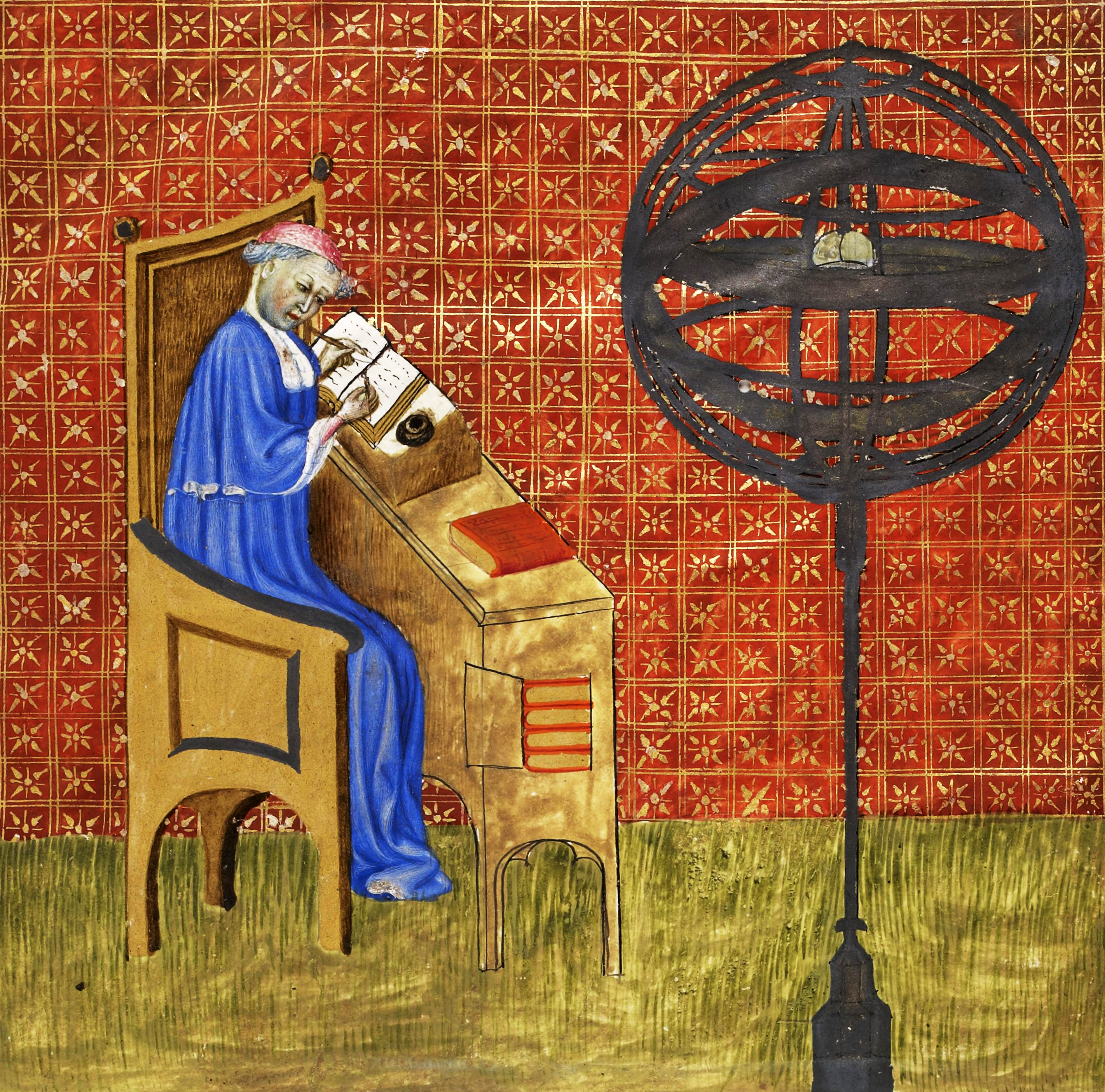
The fourteenth century scholar, Nicole Oresme, gave a particularly important analysis in his commentary on Aristotle’s On the Heavens. Aristotle’s physical argument for why the Earth should be at rest at the centre of everything was discussed in Module 2. He argued, for instance, that the Earth must be at rest because no matter where on the spherical Earth one finds oneself, a projectile directed upwards, perpendicular to the surface of the Earth, is found to fall directly back down along its path, eventually landing at the point on the Earth’s surface directly beneath its point of origin.
We now know that the projectile falls towards the Earth because massive objects are attracted through gravitation, and because the Earth is the main source of gravity in its neighbourhood. And we know that, even though the Earth is rapidly spinning, the projectile falls back to the same point as a result of the conservation of momentum, because it has the same inertia—the same state of rest—as the spinning Earth. But neither of these concepts was established in Aristotle’s time; in fact, they were only firmly established by Newton in the seventeenth century, so vertical projectile motion was still considered a problem that heliocentrism would need to overcome. But anyone familiar with Oresme’s commentary could not have failed to notice that the problem did have reasonable potential to be overcome.
With regard to the apparent motion of the stars and the apparent stasis of the Earth, Oresme wrote that this cannot be taken as evidence that the Earth actually is at rest; that the Earth’s being at rest must, in that regard, be assumed as a matter of faith. For, as he noted, one can observe only relative motion:
If a man in a smoothly riding boat, a, which is moved either slowly or rapidly, can see nothing but a second boat, b, which moves in just the same way as a… then I say that it will seem to him that neither boat is moved. And if a is at rest and b moves, it will seem to him that b moves; and if it is a that moves and b is at rest, it will still seem to him that a is at rest and that b is moved… (Kuhn, 1957).
Thus, Oresme concluded that, just as the stars would make concentric arcs across the sky if the Earth were at rest and the celestial sphere spun around it once a day, the same observation would be made if the Earth were spinning and the stars were at rest. He then moved on, after pointing out that only relative motion is observable, to demonstrate that the projectile’s motion can be accounted for as a consequence of the relativity of inertia:
[In response to Aristotle’s and Ptolemy’s argument] one may say that an arrow shot straight into the air is [also] moved rapidly eastward with the air through which it passes and with the whole mass of the bottommost [or terrestrial] portions of the universe described above, the whole [earth and air and arrow] being moved with a daily rotation. Therefore the arrow returns to the spot on the earth from which it was shot. This appears possible by analogy: if a man were on a ship moving rapidly eastward without his being aware of its motion, and if he drew his hand rapidly downward, describing a straight line against the mast of the ship, it would seem to him that his hand had only a vertical motion; and the same argument shows why the arrow seems to us to go straight up or down (Kuhn, 1957).
Oresme’s commentary is important for two reasons. First of all, it is important because it provided a good (and, according to modern physics, a valid) argument demonstrating how the Earth could be rotating and yet our observations of the physical world should still be as they are. In fact, Galileo famously gave a similar argument in his Dialogue Concerning the Two Chief World Systems (his great work, which compared the geocentric and heliocentric systems, and was banned from print for 200 years under suspicion of heresy—an event which we will discuss below). The relativity of inertia is one of the most important concepts in modern physics. Not only did it pave the way for the acceptance of heliocentrism and the rest of Newtonian physics, it also essentially motivates Einstein’s theories of relativity, the basic assumption of which (known as the principle of relativity) states that the laws of physics are independent of the state of rest that one assumes. While we are on the subject, it is worth reading Galileo’s full thought-experiment, which demonstrates this important physical phenomenon more clearly than Oresme’s:
Certainly Galileo’s argument is more elaborate than Oresme’s, but the crux was the same. Both thought-experiments demonstrate the relativity of inertia, by which all the same effects are observed regardless of the boat’s “true” inertial state. This is the reason why a vertically-directed projectile falls back to its point of origin on the Earth even though the Earth is spinning and orbiting the Sun; and arguments like Oresme’s and Galileo’s made it conceivable that this should be the case. Thus, the point was made that physical observations from a spinning Earth orbiting the Sun would be qualitatively indistinguishable from the observations one might make from a stationary Earth about which the celestial sphere rotates once a day—and therefore, that one’s choice between the two can only, from that perspective, be made as a matter of faith.
Together with similar other analyses of Aristotle’s physics, Oresme’s commentary contributed to an academic culture in which it was acceptable to question, and even to disagree with Aristotle’s logic. Despite the fact that Western Europe was in the process of rediscovering Aristotle, who was often referred to as “The Philosopher” by people like Thomas Aquinas who had worked to reconcile Aristotelian physics with Scripture, Aristotle’s works were not considered Gospel. Commentaries like Oresme’s show that the physics that late Medieval scholars were in the process of recovering was not blindly accepted. Even so, Oresme did not believe the Earth was moving around the Sun; he believed in the geocentric universe of his Christian faith. His purpose was not to provide an argument for a worldview that was essentially different from the one laid out by Aquinas or Dante, but only to show that Aristotle’s argument was not sufficient to motivate the common belief. From there, however, it was indeed a smaller step to the proposal of a heliocentric system.
 cosmiCave.org