
As noted already in this section on the night sky, the stars exist in the celestial sphere regardless of whether we can see them or not—i.e. regardless of whether it is night or day. All ancient civilisations who studied the sky recognised this. More to the point, in fact, they all recognised that once the daily revolution of the celestial sphere was taken into account, the stars’ positions are all fixed. From this perspective, it is only the Sun, Moon and planets that tend to migrate through the fixed background stars.
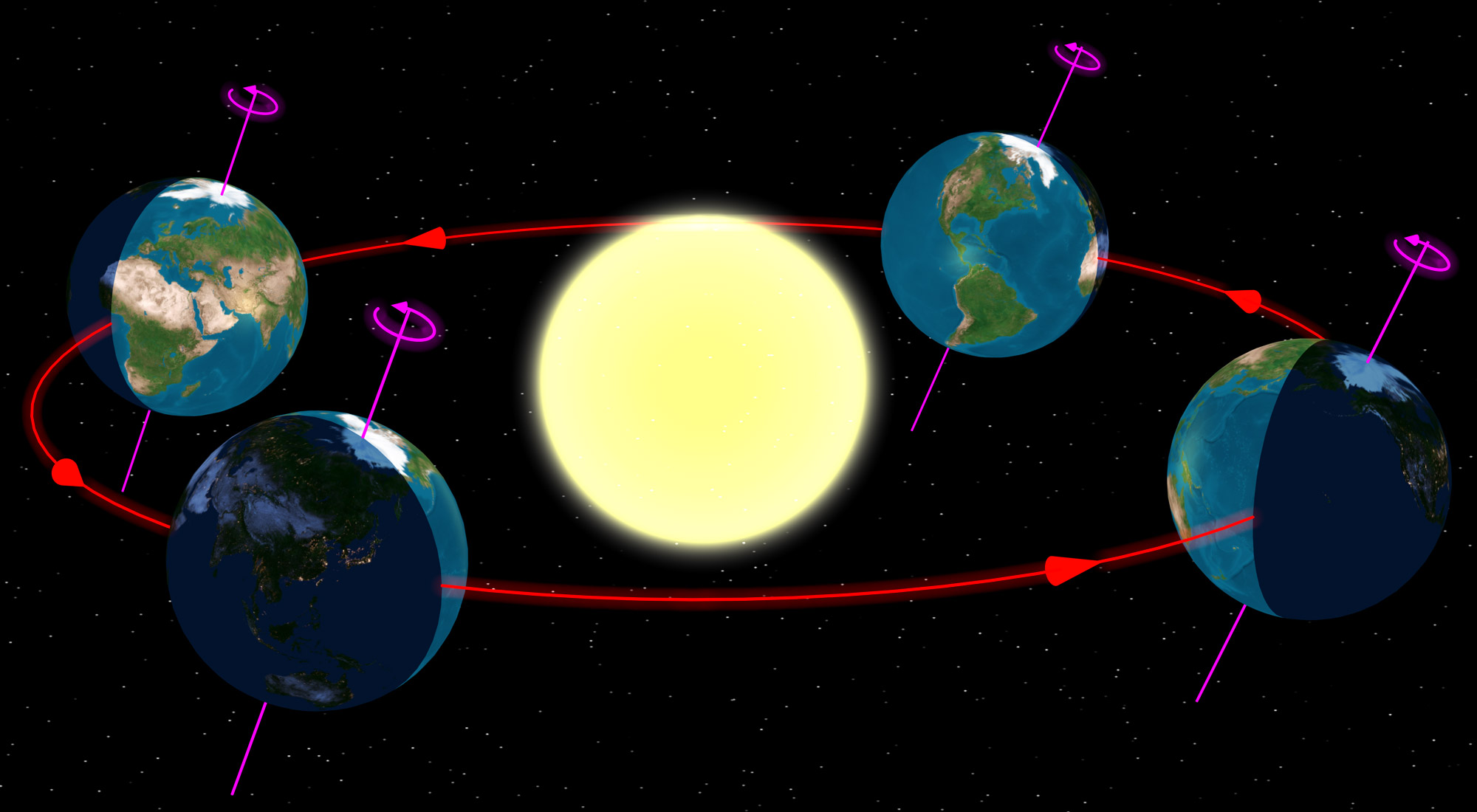
We now know that the reason the stars appear fixed in the celestial sphere is that they are so far away that any motion on their part—or, indeed, the Earth’s motion around the Sun—has a negligible effect. Furthermore, the orientation of Earth’s axis on which it spins once a day remains fixed while it orbits the Sun (see Figure 1-4). Therefore, since the Earth’s motion around the Sun is not enough to produce a noticeable change in the positions of the stars (in fact, the effect is so minute that it was not detected until 1838, a point which will be important to our discussions in Modules 2 and 3), their only apparent motion is the daily revolution due to Earth’s rotation. In essence, since the Earth’s orbital motion is insignificant on the scale of the distances to the stars (recall our earlier discussion), the Earth effectively stays in one place, spinning on its axis once a day.
Another thing that was noticed by every ancient civilisation who studied the sky was that the Sun’s location relative to the fixed stars shifts slightly from day to day and that, as a result, the stars we are able to see in the night sky shift slightly from day to day as well. The reason for this is that the Earth is orbiting the Sun roughly in a circle, and as it does so the Sun’s location relative to the background stars appears to shift. In Figure 1-4, the stars that are not visible at a given time of year are those in the half of space where the Earth is illuminated (the daytime side), while those that are visible are in the half of space where Earth is dark (the nighttime side). On the celestial sphere, this means that the Sun makes its way 360° through the stars in the course of one year—i.e. it moves slightly less than 1° through the background stars each day.
The path that the Sun takes through the fixed stars is called the ecliptic. The set of constellations that the Sun passes through is called the zodiac. And the Sun’s presence in any constellation at any time of year is the basis of astrology. In fact, the zodiac is home not just to the Sun, but to the Moon and planets as well. The reason is simple: the orbits of the Moon and all the planets lie roughly in the same plane as the Earth’s orbit around the Sun, being tilted by at most a few degrees; therefore, their projected locations on our night sky must lie very near to the ecliptic.
Learning Activity
The current positions of the Sun, Moon and planets in units of right ascension and declination can be found here. There are a few things to make note of on this page. For one, the column labeled “Sign” lists the constellation in which each Solar System object is currently located. As you know, these constellations give the general area of the sky that each object is located, and therefore will only change when an object moves an appreciable distance through the celestial sphere. However, if you reload the page after a few minutes, you should see that the right ascension and declination of each object does vary a slight amount on short timescales. Another thing you may have noticed is that the Sun, Moon and planets are located at widely varying right ascensions and declinations. This indicates that the ecliptic does not coincide with any particular declination angle. The explanation of this is closely tied to the explanation of the seasons we experience on Earth, to which we now turn.
 cosmiCave.org