
The idea that Venus once had liquid water on its surface is not supported by direct evidence from the planet itself, but by piecing together what we know about the rest of the planets and inferring from there. We know the role that liquid water plays on Earth, particularly in regard to the greenhouse effect. And our climate models tell us that above a certain temperature, well before the blackbody temperature of a planet reaches 100 °C, it should experience a runaway greenhouse effect, losing all its liquid water. Chemically speaking, since hydrogen is by far the most abundant element in our Solar System we think it should have been far more abundant on Venus in the past, and that hydrogen and oxygen should have naturally bonded to form water molecules. And we know that without a magnetic field—whatever the cause of that—photodissociation and the solar wind would remove water molecules from a planet’s atmosphere before removing heavier molecules like carbon dioxide. However, isotopic measurements by Venus Express show a high deuterium-to-hydrogen ratio in its atmosphere, consistent with the loss of a large ancient water reservoir.
It makes a great deal of sense to us that Venus should once have had an abundance of water. But due to the volcanic activity that resurfaced Venus within the past billion years, long after we think it should have lost its water, we have no geographic evidence that liquid water was ever there. The case on Mars is very different.
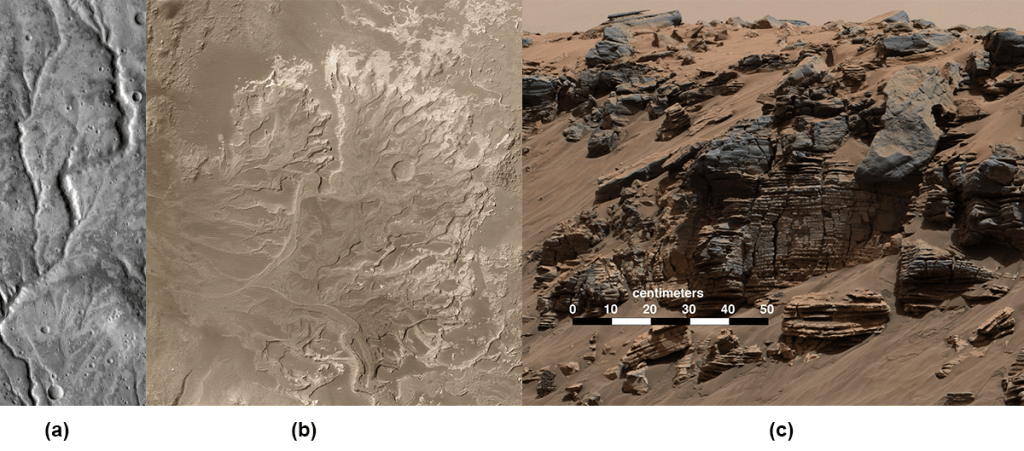
Mars once had an abundance of liquid water on its surface. The scientific evidence that supports this provides no more room for doubt than the evidence that Earth and the other planets orbit the Sun. For one thing, Mars is within the Sun’s habitable zone. At an orbital distance of 1.5 AU, its average surface temperature would be a frigid -67 °C; however, as with Earth, the greenhouse effect would have raised this to above freezing early in Mars’ history. In fact, signs of the past presence of liquid water exist across the Martian landscape. From spacecraft images and other remote sensing techniques, to explorations of Mars’ surface via landers and rovers, we have found a topography rich with dry river channels, deltas and lake beds with sedimentary deposits rich in hydrated minerals (see Figure 7-5). Perseverance has since confirmed that the Jezero Crater delta contains fine-grained clays and carbonates formed in standing bodies of water. A comprehensive description of the evidence is given in the Wikipedia article, Water on Mars.
To date, the most successful spacecraft we’ve sent to Mars is NASA’s Mars Reconnaissance Orbiter (MRO), which collects more data than all other missions combined. Over the course of more than a decade, MRO has revealed an active world, with dust devils, moving sand dunes, numerous ancient water flows, and even features once thought to be ephemeral briny flows—called recurring slope lineae—which are now believed to be dry granular flows triggered by dust or CO₂ frost activity. MRO continues to operate, approaching two decades in service. Watch the magnificent highlights of MRO’s first decade at Mars here.
The question is no longer whether or not there once was liquid water on Mars—there was! The question is, how much was there? As you’ll see in the following video, Measuring Mars’ Ancient Ocean, the current estimate based on the abundance of heavy water—water containing one deuterium atom, which is less evaporative than water which is made up of the more abundant, single-proton hydrogen isotope–in Mars’ north polar ice cap, indicates that Mars likely once had an ocean covering 15-20% of its surface, with an average depth equal to that of the Mediterranean Sea.
Despite this past abundance, today no confirmed surface liquid water has been found; dark streaks once interpreted as briny seeps are now believed to be dry avalanches of dust or sand. In the following video, you can watch the September 2015 news conference highlights where NASA scientists announced the evidence for liquid water on Mars (or view the full news conference here).
So what happened to all of Mars’ water? If Mars is in the Sun’s habitable zone, shouldn’t the greenhouse effect have enabled it to maintain its liquid water? As our previous discussions of Earth and Venus indicate, conditions suitable for the existence of liquid water on a planet require four things:
- An interior of spinning, hot molten metal with an exterior that is cooled through tectonic activity, and therefore a temperature gradient that is sufficient to generate a magnetic field through the dynamo effect,
- A magnetic field that shields the planet’s atmosphere from the solar wind,
- An atmosphere thick enough to maintain surface temperatures above freezing through the greenhouse effect, and
- A rich liquid water supply on its surface, which cycles through the atmosphere providing an essential component of the greenhouse effect, and which is critical to the planet’s tectonic activity.
All four of these are connected, and as we’ve discussed any break in the chain is expected to bring about the end of each of them. Right now, we are uncertain which gave out first on Mars, but currently the planet has none of them. While the atmospheric pressure at Mars’ surface is now only 1% of Earth’s, and is continually stripped away by the solar wind due to the lack of a global magnetic field, all the evidence for abundant liquid water in the past also indicates that both the atmosphere and magnetic field were more like Earth’s in the past. And the linear chain of shield volcanoes in Mars’ Tharsis bulge are thought to reflect long-lived mantle plumes beneath a largely stationary lithosphere (Mars lacks plate tectonics), producing major volcanic centers like Olympus Mons and the Tharsis Montes (see Figure 7-6). Data from NASA’s InSight lander (2018–2022) revealed a liquid or partially molten core and ongoing seismic activity, further refining our understanding of Mars’ internal structure.
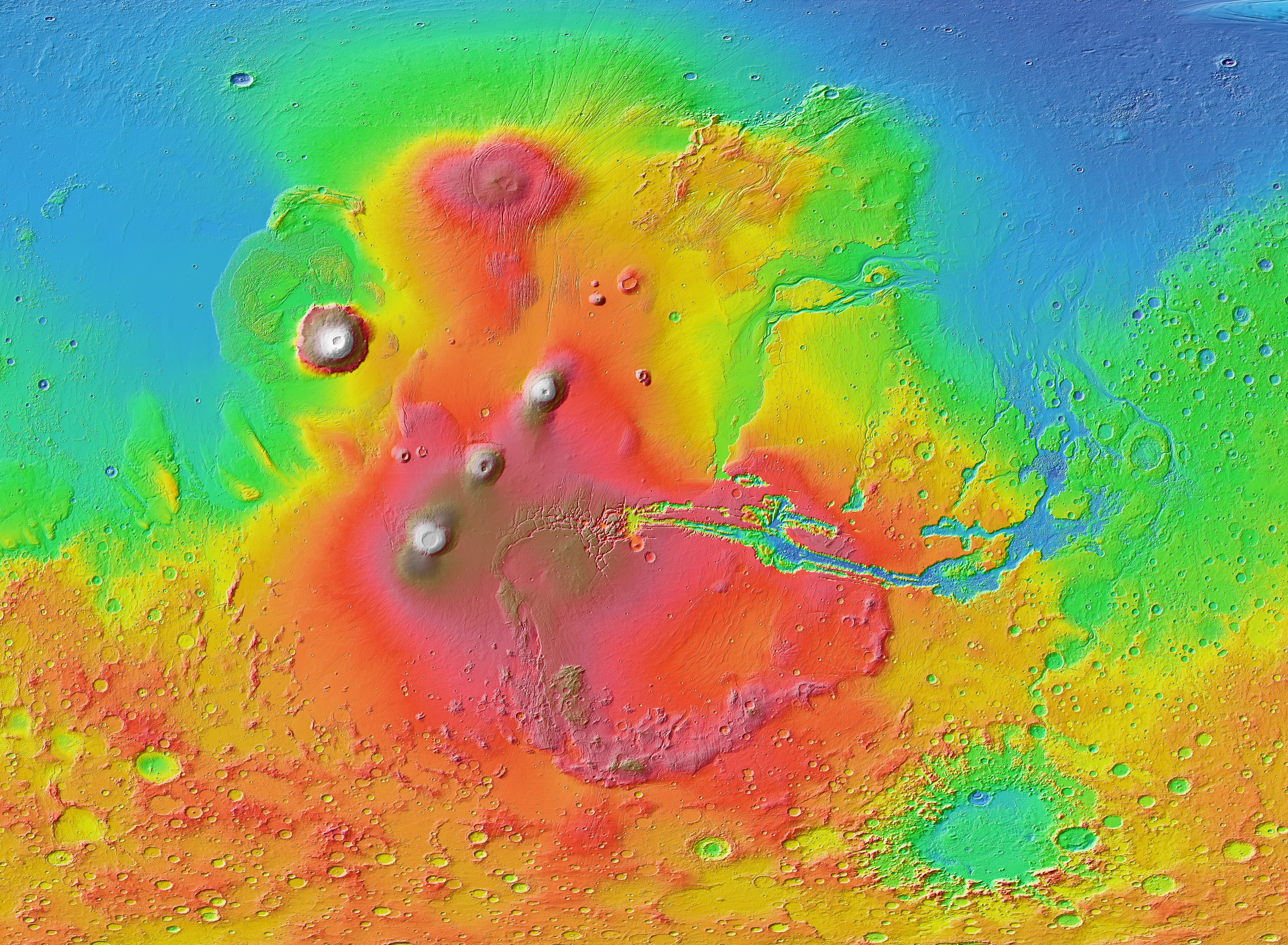
Mons are thought to be evidence that Mars once had tectonic activity. Source.
Investigating the disappearance of Mars’ surface water is one of NASA’s prime objectives. It may be that Mars is too small and its core cooled too quickly, eventually shutting down the magnetic dynamo. The Tharsis bulge is enormous, and provides good evidence that Mars’ crust is extremely thick, supporting the idea that the Martian interior has cooled significantly. Perhaps even before Mars had completely lost its magnetic field, volcanic activity could have ceased, cutting off the greenhouse gases that volcanoes provide and weakening the atmosphere. That, combined with the fact that Mars is far less massive than Earth or Venus, so its gravitational field is weaker and loses atoms to the solar wind more easily, may have led to great atmospheric depletion even if Mars still had a weak global magnetic field. Such an occurrence would have had a feedback loop similar to the runaway greenhouse effect on Venus, but in reverse: any loss of atmosphere is a loss of mass from the planet; if Mars was already losing its atmosphere due to a weak gravitational field, every bit of mass that was subsequently lost would have increased the rate at which this occurred.
Any one of these scenarios might have occurred to some extent in Mars’ past; but if we want to make informed guesses about the degree to which any of them actually did occur, we need to collect scientific evidence. NASA recently launched a mission that will investigate this problem, literally from the top-down. Launched in 2014, the Mars Atmosphere and Volatile EvolutioN (MAVEN) mission remains operational and continues to measure the rate at which the solar wind strips gas from Mars’ upper atmosphere. In the following video, you’ll see the highlights from the November 2015 news briefing where NASA scientists reported the mission’s initial findings (or view the full briefing here).
If Earth does become uninhabitable in the next billion years, and if humans are still around when that happens, we would like to find an alternate place to live. In that case, it seems that Mars may provide the best chance for survival. If we can work out how Mars has lost its atmosphere, it may help us to work out a way for life to exist there.
Beyond the selfish problem of our own survival, humans also tend to be curious about our place in the Universe. Are we alone? If Mars was once habitable, it is natural to ask whether it was also once inhabited? Determining whether Mars was once able to support microbial life is the goal of NASA’s Curiosity Rover, a portable laboratory which landed in the summer of 2012 and successfully discovered chemical and mineral evidence of past habitable environments in Mars’ Gale Crater. Curiosity continues to operate in Gale Crater, analysing organic molecules and seasonal methane variations. Upper-atmosphere measurements by ESA’s ExoMars Trace Gas Orbiter place very low limits on methane, highlighting an unresolved discrepancy with Curiosity’s local detections.
While Curiosity continues to collect scientific data, on Feb 18, 2021, Curiosity’s successor, the Perseverance Rover successfully landed on Mars. You can watch Perseverance’s descent in the following video:
You can read more about Perseverance at the mission website. There, you’ll find an important distinction between the mission goals of Curiosity and Perseverance: while Curiosity’s aim was to determine whether conditions on Mars were ever suitable to support microbial life, Perseverance actually has the capability of searching for signs of past life, and its goal is therefore to search for signs of ancient microbial life on Mars! More specifically, Perseverance has been actively drilling for samples of rock and soil that it has cached in sealed tubes for future pickup by the Mars Sample Return mission—in which a launcher will collect the samples and ferry them back to Earth for analysis. Perseverance also deployed the Ingenuity helicopter—the first powered flight on another planet!
Perseverance has also been sending back stunning images for us to enjoy. You can browse the full list of images on the mission website or view a sample of some of the best early shots taken in this BBC article. Finally, you can also watch the full (2-hr) recording of the Perseverance Feb 18, 2021 landing event here.
Learning Activity
Regardless of our primary aim in exploring Mars, the goal is always to learn as much about The Red Planet as we can. Phil Plait’s Crash Course Astronomy video about Mars provides a great overview. A number of discoveries that have been made by recent missions to Mars are not discussed in the video, which was created in April 2015. Use the video as a historical benchmark, noting which discoveries (e.g., InSight seismic results, Perseverance’s sample caching, confirmation of dry slope flows) have since refined or superseded the information presented.
 cosmiCave.org