
In the previous section, we explored a number of properties of the Sun that can be determined just from its spectrum. We are able to accurately measure its temperature, the amount of energy it emits at all wavelengths, and its detailed chemical composition. But the Sun exists right right in our own backyard, so to speak. It takes up half a degree of our sky. As such, we are in fact able to learn a lot more by studying our Sun than any other star in the Universe. In fact, the same goes for all the objects in our Solar System: these are the objects that we are not limited to studying from light-years away. They’re our own private astrophysical laboratory. We can use the things we observe here and apply that knowledge to observations we make of objects throughout the Universe.
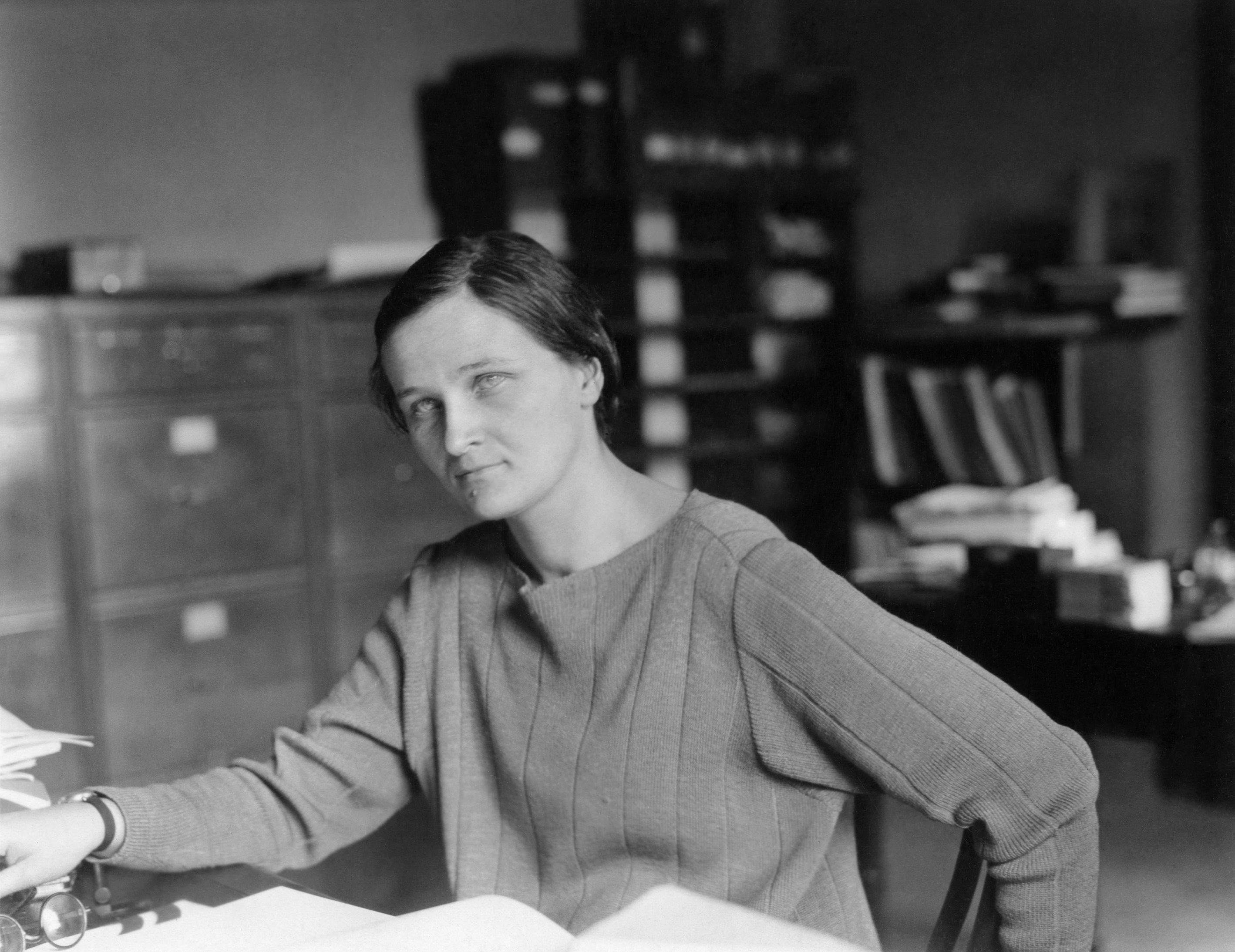
One of the most important advances in the field of stellar spectroscopy came when, in her 1925 PhD thesis, Cecilia Payne invented a method of interpreting the chemical composition of the Sun and other stars by analysing their spectra. The key element in Payne’s theory was her realisation that it should not only be the strengths of absorption lines that determines how abundant they are in stars, but the surface temperature of a star and density of its atmosphere as well. What Payne realised is that these factors must be important when determining whether an atom will have electrons in the right energy levels to absorb light at visible wavelengths.
Payne’s initial calculations showed that despite the presence of strong absorption lines in heavier elements such as calcium, sodium, and iron, those atoms are not all that abundant. Instead, she found that more than 90% of the atoms in the Sun should be hydrogen, and that helium, which is nearly invisible in the Sun’s spectrum, makes up most of the rest. Payne’s work was not immediately taken up by other astronomers, who found it hard to believe that so much of the Sun should be hydrogen and helium—after all, other elements like oxygen, magnesium and iron, which also show up strongly in the Sun’s spectrum, are far more abundant on Earth. However, as theories of the Big Bang and the way stars operate started to emerge in the 1930s and 1940s, the scientific community recognised just how valuable her work had been.
Since the pioneering work done by Payne, astronomers have pieced together a complex picture of what a star is, which has largely come from watching the Sun. We now know that the Sun has a dynamic atmosphere that is completely dominated by its magnetic field. As you saw in Module 4, Maxwell’s theory of light as electromagnetic radiation tells us that electricity and magnetism are two sides of the same phenomenon, called electromagnetism. In particular, this theory tells us that moving electric charges generate a magnetic fields. In terms of solar activity, observations show that the Sun’s surface is covered in eruptions of gas that reach distances of more than 100,000 km before arcing back down. These arcs carry large amounts of charged particles that are understood to be connected with currents reaching deep into the Sun’s interior, and provide the best indication of the Sun’s magnetic activity.
In November 2015, NASA released a 30-minute video of this solar activity, composed by piecing together high definition images taken at 10 different wavelengths every 12 seconds. While the whole video is spectacular, in just seconds you should already begin to appreciate the dynamic nature of the Sun’s magnetic weather.
The source of solar energy
The evidence clearly shows that the Sun is a dynamic and energetic object, but what is the source of energy that fuels its activity? In order to answer this question, we need to dig a little deeper. Literally. The source of all the Sun’s energy—the 3.4 × 1026 watts of electromagnetic radiation it emits, plus all the atmospheric activity captured in the above video—comes from nuclear reactions in its core. The theory describing how the Sun generates this enormous amount of energy was developed in the 1930s, but the final piece of evidence needed to confirm it was only collected this century, in a neutrino observatory 2 kilometres underground in Sudbury, Ontario.
Prior to the 1930s, the source of the Sun’s energy had been a significant problem. The huge amount of it could be determined, but no source was known that could sustain the production of so much light for the known age of the Solar System. Given the Sun’s mass (determined by celestial mechanics), if the source of its energy happened to be fire it would run out of fuel in a mere 10 thousand years. If the Sun radiated by contracting, converting gravitational potential energy into light, its maximum lifetime would be only 25 million years. The problem was, that the geographical evidence indicated that the Earth, and by extension, the rest of the Solar System, was more than 4 billion years old.
Finally, in the early part of the 20th century three important discoveries were made that allowed physicists to develop a plausible mechanism that could sustain the energy output of the Sun for 10 billion years. Those were the discovery of the quantum theory of atoms, Payne’s discovery that the Sun is mostly hydrogen, and Einstein’s prediction from relativity theory, that there is an enormous amount of energy bound up in matter.
Einstein’s famous formula, E = mc2, tells us that mass can be converted into pure energy. Furthermore, it says that when this happens the amount of energy released is equal to the mass multiplied by the square of the speed of light. The speed of light is a huge number—light can orbit the earth 10 times in a second—which means that every gram of matter in the Sun is a huge source of potential energy. Given this, and the fact that the Sun is mostly a bunch of protons (i.e. ionised hydrogen), the problem then became to work out how to convert those hydrogen atoms into pure energy. The solution is a process called nuclear fusion.
In contrast to the attraction between protons and electrons, which are oppositely charged, the Coulomb force law discussed earlier in this module tells us that like charges repel each other by the same amount. When two protons or two electrons are brought close together, this means the repulsive force between them must exponentially increase. But in the centre of the Sun, the temperature and pressure are so great that protons can overcome this electrical repulsion and collide with one another. Following a series of reactions, the Sun combines four hydrogen atoms into a single helium atom, releasing high energy photons (gamma rays) and neutrinos in the process. And the energy carried away by those gamma rays is what powers all the Sun’s activity.
The gamma rays produced in the core of the Sun are not quickly radiated out into space, but bounce around for millions of years, from atom to atom, heating the Sun up. When the energy of a single gamma ray is actually released at the Sun’s surface, it has transformed into thousands of photons of (mostly) visible light, which are emitted as (approximately) blackbody radiation.
In contrast, because the neutrinos that are produced in the same series of reactions are electrically neutral, they mostly pass right through the Sun without a single interaction. Detection of the very small number of neutrinos from the Sun that are expected to interact with particles in the Earth would therefore be an important confirmation of this solar energy generation theory.
When physicists began looking for these solar neutrinos, however, they ran into a problem: only about one-third of the expected neutrinos were showing up in their detectors. The solution to this solar neutrino problem, as it came to be known, was that these neutrinos themselves transform en route to Earth, oscillating between three different types.
In order to detect all three types of neutrinos coming from the Sun, scientists constructed a large detector in an abandoned mine in Sudbury, Ontario, deep enough underground that the faint signal of neutrinos would not be drowned out by other sources. The confirmation that all three types of neutrino were indeed coming from the Sun in the amounts that had been theoretically predicted, was announced after the Sudbury Neutrino Observatory’s detector ran from 1999-2006. In October 2015, Arthur B. McDonald, the director of the experiment, was awarded the Nobel Prize in Physics for the discovery.
This is a very rough sketch of the process through which astrophysicists believe that energy is generated in the core of the Sun and all other stars in their main stage of evolution, as well as the experimental evidence that supports the theory. The full picture is fascinating, but lies beyond the scope of what we are able to cover in this course. Further details about the Sun are covered in textbook chapters 15 and 16, which you are encouraged to explore if you have interest in learning more about our fascinating Star; however, only the sections listed in the required readings for this module are necessary for the exams.
Throughout their life cycles, stars generate more than just helium. They generate nearly all the elements in the periodic table through the fusion reactions that cause them to heat up and and radiate as visible blackbodies. As the infographic in Figure 5-13 indicates, many of these elements are in fact generated in their very last moments, when they explode as supernovae. If you are interested in pursuing this fascinating subject further, to learn how all this happens, you are encouraged to enrol in a stellar astronomy course.

 cosmiCave.org
