
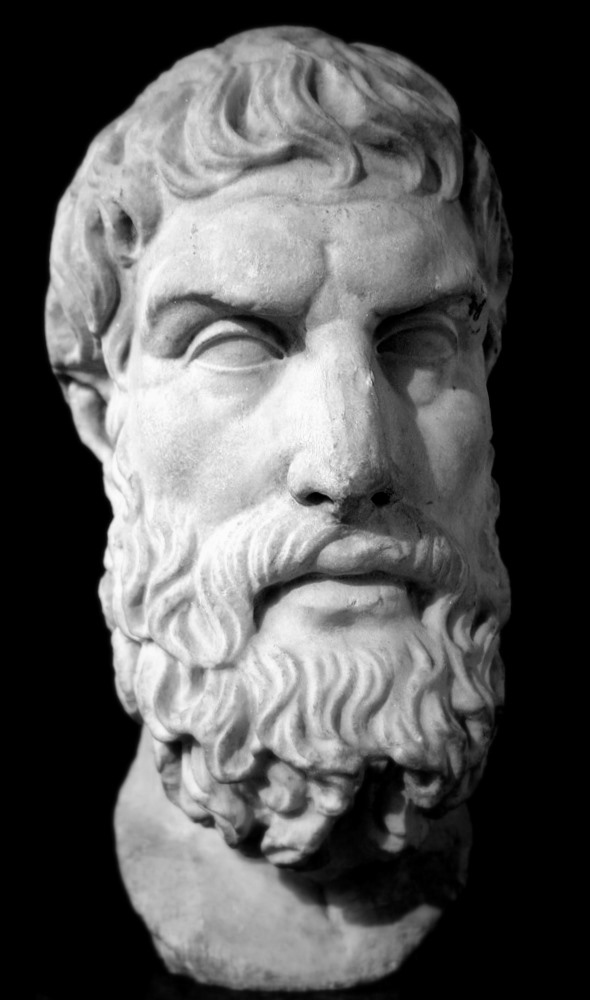
Epicurus. Source.
Are we alone in the Universe? Is our Solar System unique among the stars? Is there life beyond Earth?
Throughout history, people have speculated about the existence of life elsewhere in the universe. The ancient Greek philosopher Epicurus, for example, wrote that “there are infinite worlds both like and unlike this world of ours…Furthermore, we must believe that in all worlds there are living creatures and plants and other things we see in this world” (Bailey, 1926).
Epicurus’ “worlds” were different from the worlds we now think of. He did not think of the stars as individual solar systems that could be observed or even travelled to through space. Instead, each world was like ours: an earth, surrounded by air and a rotating celestial sphere.
Nearly two thousand years after Epicurus, however, Giordano Bruno’s speculations about worlds beyond our own were much closer to our current views:
There is a single general space, a single vast immensity… in it are innumerable globes like this one on which we live and grow (Singer, 1950).
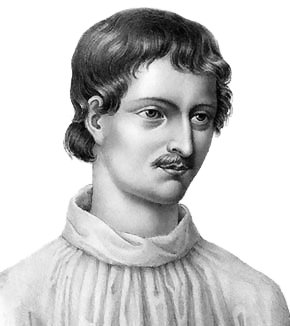
Giordano Bruno. Source.
Bruno wrote this in his work De L’infinito Universo et Mondi (On the Infinite Universe and Worlds), published in 1584. Beginning in 1593, he was tried for heresy by the Roman Inquisition, and in 1600 he was found guilty of holding beliefs that conflicted with core Catholic doctrines including eternal damnation, the Holy Trinity, the divinity of Christ, the virginity of Mary, and transubstantiation, and was burned at the stake.
Because of his views of space and the existence of innumerable worlds beyond our own, Bruno is often portrayed as a martyr for science. Just ten years after his execution, Galileo turned his telescope to the sky and found that the Moon was covered in mountains and craters, that the Sun was a rotating sphere, and that Jupiter was a world orbited by moons of its own. The Scientific Revolution that followed culminated in the publication of Newton’s Principia, in which he formulated his law of universal gravitation and used it to explain planetary motion. Comparing our Solar System to other stars, he wrote,
And if the fixed stars are the centres of other like systems, these, being formed by the like wise counsel, must be all subject to the dominion of One (Hawking, 2002).
It would be another three hundred years before the first planet beyond our Solar System was discovered.
Today, that long wait is over. In the past three decades, astronomers have confirmed more than 5,600 planets orbiting other stars — a stunning validation of what thinkers like Bruno could only imagine. These discoveries have transformed our understanding of planetary systems, revealing that worlds come in an astonishing variety of sizes, orbits, and compositions. In the next two sections, you’ll learn how the first such planets were found — in places no one expected — and how these discoveries launched a new era in our exploration of the cosmos.
 cosmiCave.org