
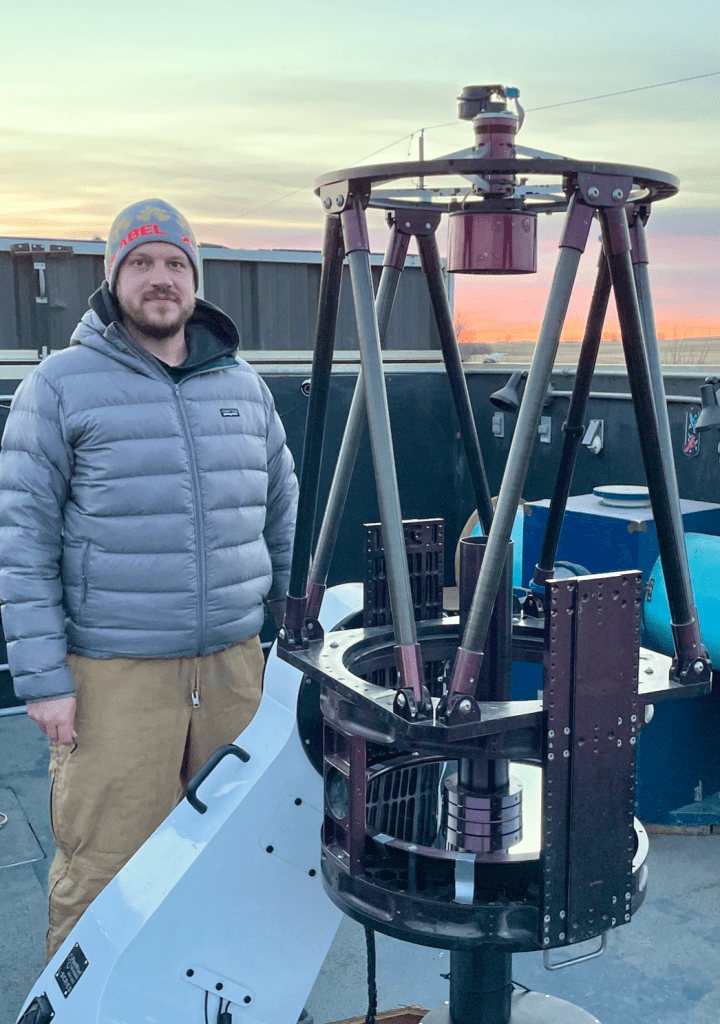
I am a physicist at the University of Saskatchewan in Saskatoon, Canada, working at the foundations of cosmology, relativity, and the ontology of space-time. My work focuses on the conceptual structure of modern physics: not just what the equations say, but what physicists claim follows from them — and whether those claims are actually licensed.
Over the past several years my research has increasingly concentrated on exposing category errors and unexamined metaphysical assumptions in contemporary space-time physics, particularly around black holes, cosmology, and the interpretation of relativity. I am deeply interested in where physics quietly imports philosophical commitments without acknowledging them, and in what collapses when those commitments are removed — clarifying the basic conceptual architecture of physics so we may come to a better understanding of the universe.
I write both for professional audiences and for the wider public. The goal is the same in both settings: to make the actual logical structure of our theories visible again.
I am the author of Cosmological Relativity, an ongoing theoretical framework that reconstructs relativistic physics around a realist, evolving cosmic geometry rather than a block-universe ontology. This work develops a coherent alternative to dominant interpretations of space-time that treat existence as static and time as illusory.
Research
Foundations of Space–Time
My doctoral research and continuing work are focused on the metaphysical and logical architecture of relativity and cosmology. This includes critical analysis of eternalism, operationalist interpretations of space-time, and subtle category errors that have become deeply embedded in the basic conceptual architecture of physics.
This line of work led to the development of Cosmological Relativity: a framework that distinguishes sharply between physical geometry and its mathematical representation, and reconstructs cosmic expansion, time, and gravitation without recourse to block-universe metaphysics or completed singularities.
My current research also addresses gravitational collapse and black holes, with an emphasis on separating what the formalism actually entails from what physics culture has imported into it. A central theme is identifying which widely accepted claims are not merely controversial, but false — in the strict sense that they are not entailed by the theory and in some cases are ruled out by its causal structure.
Recent essays on topics ranging from the history and philosophy of science and astronomy, to philosophy of time, relativity and black holes can be found here.
Astronomy and Astrophysics
I’ve published in peer-reviewed journals such as The Astrophysical Journal, coordinating research projects involving double stars, binary stars, variable stars, and time-series analysis.
Physics and Astronomy Education
I also conduct research into how students engage with astronomy and the philosophy of science—especially through hands-on and narrative-based approaches.
Teaching
Robotic Telescopes & Observational Programs
I’ve directed student research using remotely operated observatories, integrating real-world observation with course content.
Courses Taught
From introductory astronomy to advanced cosmology, I’ve taught a wide range of undergraduate and honours courses—always aiming to cultivate wonder, clarity, and critical thinking.
Course materials published on this website can be accessed here.
Outreach
I have led public astronomy initiatives including observing nights, citizen-science collaborations, and school-based programs. More recently, my outreach has focused on public intellectual work: writing designed to re-open foundational questions in physics that are routinely treated as settled.
My essays have appeared in outlets such as The Conversation and SciTechDaily and been republished by platforms including Space.com, Phys.org, and ScienceDaily, reaching international audiences. These pieces explore the conceptual errors that shape modern cosmology and the consequences of treating mathematical abstractions as physical objects. These can be accessed here.
This site is where the longer versions live.
 cosmiCave.org