
When we look to the horizon, Earth appears flat. But the changing altitude of stars as we move north or south—and the curved shadow cast during a lunar eclipse—revealed to Aristotle that Earth is in fact a sphere. The stars, too, seem to orbit around us each night in perfect concentric arcs. For millennia, people believed this motion was real. But Copernicus saw what others had missed: the stars only appear to move. It’s Earth that rotates.
The world doesn’t feel like it’s moving—neither spinning on its axis nor racing through space. But Galileo showed why: motion that’s smooth and steady leaves no trace in our senses. Inertial motion is invisible to us.
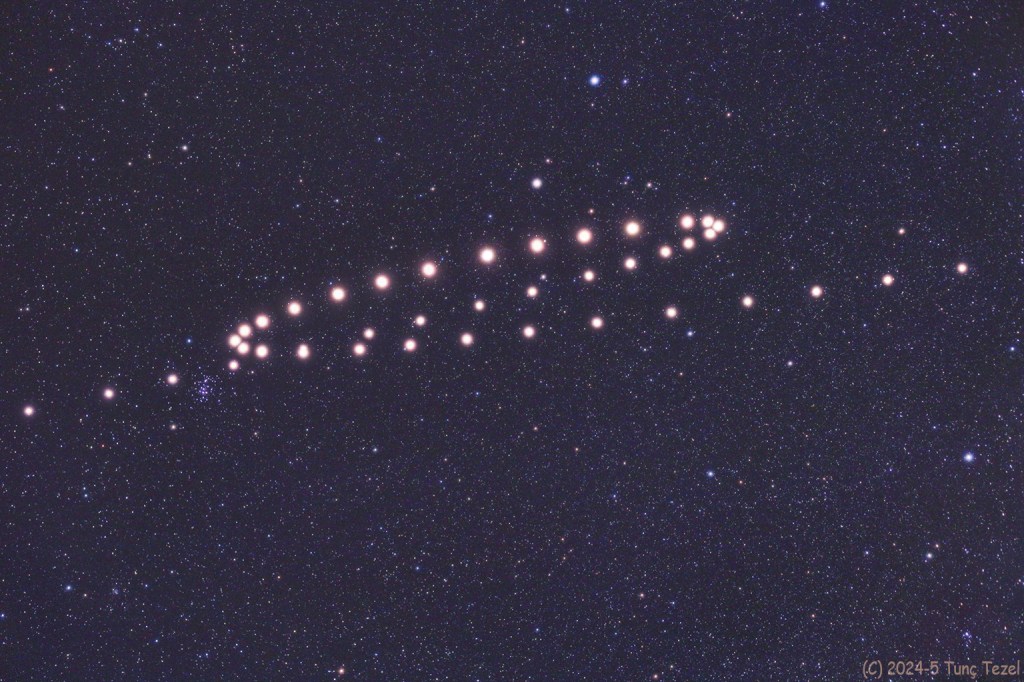
The Sun and planets, meanwhile, seem to trace looping paths against the background stars, sometimes pausing or reversing course. For over a thousand years, astronomers tried to model these motions exactly as they appeared—adding epicycles, deferents, and other tricks to match what they saw. But Kepler uncovered a deeper truth: the planets don’t actually loop. What we see is a projection—a side effect of our own orbit and shifting perspective.
This pattern runs through the history of science: we begin by describing appearances, but over time, those appearances turn out to be misleading. The task of science is to move beyond them—to uncover the structure that gives rise to what we see.
Earth looks flat, but isn’t. The stars seem to revolve, but don’t. We feel at rest, but we’re not. The planets appear to wander—but that motion, too, is an illusion. In each case, what we observe is a projection—a shadow cast by reality, distorted by our limited perspective. And science flourishes when we learn to tell the difference.
Beyond the Shadows

Two thousand years before Copernicus, Plato imagined a cave where prisoners sat facing a wall, seeing only the shadows cast by objects behind them. To those who had never seen anything else, the shadows were reality. But if one were to turn around and step outside, they would slowly come to understand the world that had cast those shadows—a world brighter, stranger, and more intricate than they ever imagined.
Plato’s allegory captures something essential about science. Again and again, we’ve discovered that the world is not as it seems—that what we observe is shaped by motion, perspective, and structures that lie hidden beneath the surface. Astronomy gave birth to science not by mapping appearances, but by learning to look past them. The Earth’s flatness, the stars’ nightly motion, the wandering of the planets—each illusion fell away when we found the deeper patterns behind the projection.
Science advances when we learn to question what we see. It asks us to turn around, to examine the source of the shadows, and to glimpse the geometry behind the glow. That turn—from appearance to explanation—is where understanding begins.
A Place for Turning Around
This site exists for those moments of turning—when the shadows no longer satisfy, and the work of disentangling begins.
Here you’ll find essays, teaching materials, and tools for deeper inquiry, all aimed at a single purpose: to practice science in its fullest sense—not merely as the description of appearances, but as the search for what lies beneath them. Some posts dissect modern cosmology and the philosophy of space and time. Others explore language, logic, or metaphysical assumptions that shape how we think. Still others are built for students: astronomy labs, lecture notes, conceptual frameworks that aim to sharpen understanding by lifting the veil of projection.
All of it follows the same path: from surface to structure, from illusion to insight, from the flicker on the wall to the source of the light.
Whether you’re here to explore space-time, cosmology, physics, or philosophy—or simply because you’ve sensed there must be more to the world than what meets the eye—welcome. The road to reality lies in the shadows. But only if we learn how to read them.

 cosmiCave.org